SQLAlchemy
Data Science @ Statnett
Simeon Simeonov
Agenda
- SQLAlchemy - Design & overview
- SQLAlchemy - A small practical example
- Q & A
What is SQLAlchemy?
SQLAlchemy is a Python library created by Mike Bayer to provide a high-level Pythonic interface to RDBMS such as PostgreSQL, SQLite, MySQL, Oracle, DB2.
SQLAlchemy includes RDBMS-independent SQL expression language and an object-relational mapper (ORM).
Why use SQLAlchemy?
free software - free as in "freedom" (MIT licensed)
portability - the programming interface is independent of the type of RDBMS and connector used
security - no more SQL injections
abstraction - no need to bother with complex JOINs
object-orientation - you work with objects instead of tables and rows
performance - exploits the likehood of reusing a particular query
flexibility - you can override almost anything
Basic architecture
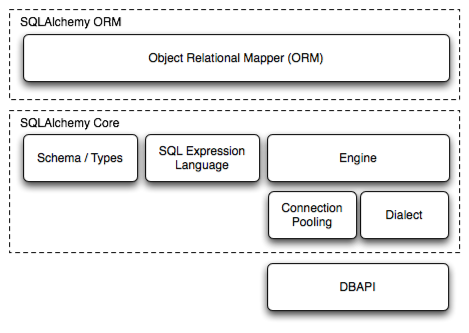
SQLAlchemy consists of several components, including the ORM.
- Engine- manages the connection pool and the RDBMS-independent SQL dialect layer
- MetaData - used to collect and organize information about your table layout (schema)
- SQL expression language - provides an API to execute your queries and updates against your tables, all from Python, and all in a database-independent way (low-level interface)
- ORM - provides a convenient way to add database persistence to your Python objects without requiring you to design your objects around the database, or the database around the objects (high-level interface)
- Session - establishes all conversations with the RDBMS and represents a "holding zone" for all the objects which you've loaded or associated with it during its lifespan
Example
SQLAlchemy gives us the choice between classical mapping and the newer declarative mapping
              import sqlalchemy
              sqlalchemy.__version__
              # Out: '1.3.23'

              from sqlalchemy import create_engine

              # engine = create_engine("postgresql+psycopg2://user:zipassword@localhost/mydb" , echo=True)
              # The string form of the URL is dialect+driver://user:password@host/dbname[?key=value..],
              # where dialect is a database name such as mysql, oracle, postgresql, etc.,
              # and driver the name of a DBAPI, such as psycopg2, pyodbc, cx_oracle
              # The echo flag is a shortcut to setting up SQLAlchemy logging,
              # which is accomplished via Python’s standard logging module.
              # engine = create_engine("sqlite:///library.db", echo=True)
              engine = create_engine("sqlite:///:memory:", echo=True)

              from sqlalchemy import Column, ForeignKey, Integer, String, Table

              metadata = MetaData()

              authors_table = Table(
                  "authors",
                  metadata,
                  Column("author_id", Integer, primary_key=True),
                  Column("name", String),
              )  # Column("name", String(50)) is possible

              books_table = Table(
                  "books",
                  metadata,
                  Column("book_id", Integer, primary_key=True),
                  Column("title", String),
                  Column("description", String),
                  Column("author_id", ForeignKey('authors.author_id')),
              )

              metadata.create_all(engine)  # creates the tables
Example (cont...)
Use of SQL expression language
              insert_stmt = authors_table.insert(bind=engine)
              type(insert_stmt)
              # Out: <class 'sqlalchemy.sql.expression.Insert'>
              print(insert_stmt)
              # Out: INSERT INTO authors (id, name) VALUES (:id,:name)

              compiled_stmt = insert_stmt.compile()
              print(compiled_stmt.params)
              # Out: {'id': None, 'name': None}

              insert_stmt.execute(name="Alexandre Dumas")  # insert a single entry
              insert_stmt.execute([{"name": "Mr X"}, {"name": "Mr Y"}])  # a list of entries

              metadata.bind = engine  # no need to explicitly bind the engine from now on
              select_stmt = authors_table.select(authors_table.c.id==2)
              result = select_stmt.execute()
              result.fetchall()
              # Out: [(1, 'Mr X')]

              del_stmt = authors_table.delete()
              del_stmt.execute(whereclause=text("name='Mr Y'"))
              del_stmt.execute()  # delete all
Example (cont...)
Use of classical mapping
              from sqlalchemy.orm import backref, mapper, relation

              class Author:
                  def __init__(self, name):
                      self.name = name

                  def __str__(self):
                      return self.name


              class Book:
                  def __init__(self, title, description, author):
                      self.title = title
                      self.description = description
                      self.author = author

                  def __str__(self):
                      return self.title

              mapper(Book, books_table)
              mapper(Author, authors_table, properties = {"books": relation(Book, backref="author")})
Example (cont...)
Doing the same thing the easy way with declarative mapping
              from sqlalchemy.ext.declarative import declarative_base
              from sqlalchemy.orm import relationship, backref

              Base = declarative_base()

              class Author(Base):
                  __tablename__ = "authors"

                  author_id = Column(Integer, primary_key=True)
                  name = Column(String)

                  def __init__(self, name):
                      self.name = name

                  def __str__(self):
                      return self.name


              class Book(Base):
                  __tablename__ = "books"  # self.__table__ will be available for our objects

                  book_id = Column(Integer, primary_key=True)
                  title = Column(String)
                  description = Column(String)
                  author_id = Column(Integer, ForeignKey("authors.author_id"))
                  author = relationship(Author, backref=backref("books", order_by=title))

                  def __init__(self, title, description, author):
                      self.title = title
                      self.description = description
                      self.author = author

                  def __str__(self):
                      return self.title

              Base.metadata.create_all(engine)  # create tables
Example (cont...)
Creating instances
              from sqlalchemy.orm import sessionmaker

              Session = sessionmaker(bind=engine)  # bound session
              session = Session()

              author_1 = Author("Richard Dawkins")
              author_2 = Author("Matt Ridley")

              book_1 = Book("The Red Queen", "A popular science book", author_2)
              book_2 = Book("The Selfish Gene", "A popular science book", author_1)
              book_3 = Book("The Blind Watchmaker", "The theory of evolutio", author_1)  # typo

              session.add(author_1)
              session.add(author_2)
              session.add(book_1)
              session.add(book_2)
              session.add(book_3)
              # or simply session.add_all([author_1, author_2, book_1, book_2, book_3])

              # session.flush()
              session.commit()  # flushes (issues the statements and sends them to the RDBMS) and commits

              book_3.description = "The theory of evolution"  # update the object
              book_3 in session   # check whether the object is in the session
              # Out: True

              session.commit()
Example (cont...)
Queries
              session.query(Book).order_by(Book.book_id)  # returns a Query instance with a .statement attribute
              session.query(Book).order_by(Book.book_id).all()  # returns an object-list

              # return all book objects where title == "The Selfish Gene"
              session.query(Book).filter(Book.title == "The Selfish Gene").order_by(Book.book_id).all()

              # using LIKE
              session.query(Book).filter(Book.title.like("The%")).order_by(Book.book_id).all()

              query = session.query(Book).filter(Book.book_id == 9).order_by(Book.book_id)
              query.count()  # returns 0
              query.all()  # returns an empty list
              query.first()  # returns None
              query.one()  # raises NoResultFound exception

              query = session.query(Book).filter(Book.book_id == 1).order_by(Book.book_id)
              book_1 = query.one()
              book_1.description  # returns "A popular science book"
              book_1.author.books  # returns a list of Book-objects representing all the books from the same author.

              # get a list of all Book-instances where the author"s name is "Richard Dawkins"
              session.query(Book).filter(Book.author_id == Author.author_id).filter(Author.name == "Richard Dawkins").all()
              session.query(Book).join(Author).filter(Author.name == "Richard Dawkins").all()
              session.query(Book).\
                  from_statement("SELECT b.* FROM books b, authors a WHERE b.author_id = a.author_id AND a.name=:name").\
                      params(name="Richard Dawkins").all()
              session.query(Book).filter(Book.author == author_1).all()
Some nice features
              import pandas as pd

              from sqlalchemy import func

              class Book(Base):
                  # ...
                  author = relationship(
                      Author, backref=backref("books", lazy="dynamic", order_by=title)
                  )
                  # ...

                  @hybrid_property
                  def newly_arrived(self):
                      return self.book_id > 2

                  @newly_arrived.expression
                  def newly_arrived(cls):
                      return cls.book_id > 2
                      # return func.abs(cls.book_id) > 2

              # .books is now a Query object
              query = author_obj.books.filter(Book.title.ilike("%red%"))

              session.query(Book).filter(Book.newly_arrived.is_(True)).all()
              # Out: [<__main__.Book at 0x7f132bdf0130>]
              # WHERE (abs(books.book_id) > ?) IS 1  ... in the case of func.abs

              # with Pandas
              df = pd.read_sql_table("my_table", con=session.get_bind())  # or con=engine

              df = pd.read_sql_query(query.statement, engine)